

Half of Our Children Sleep Through the Sound Meant to Save Them
What a failing smoke alarm reveals about how little we think about sound.
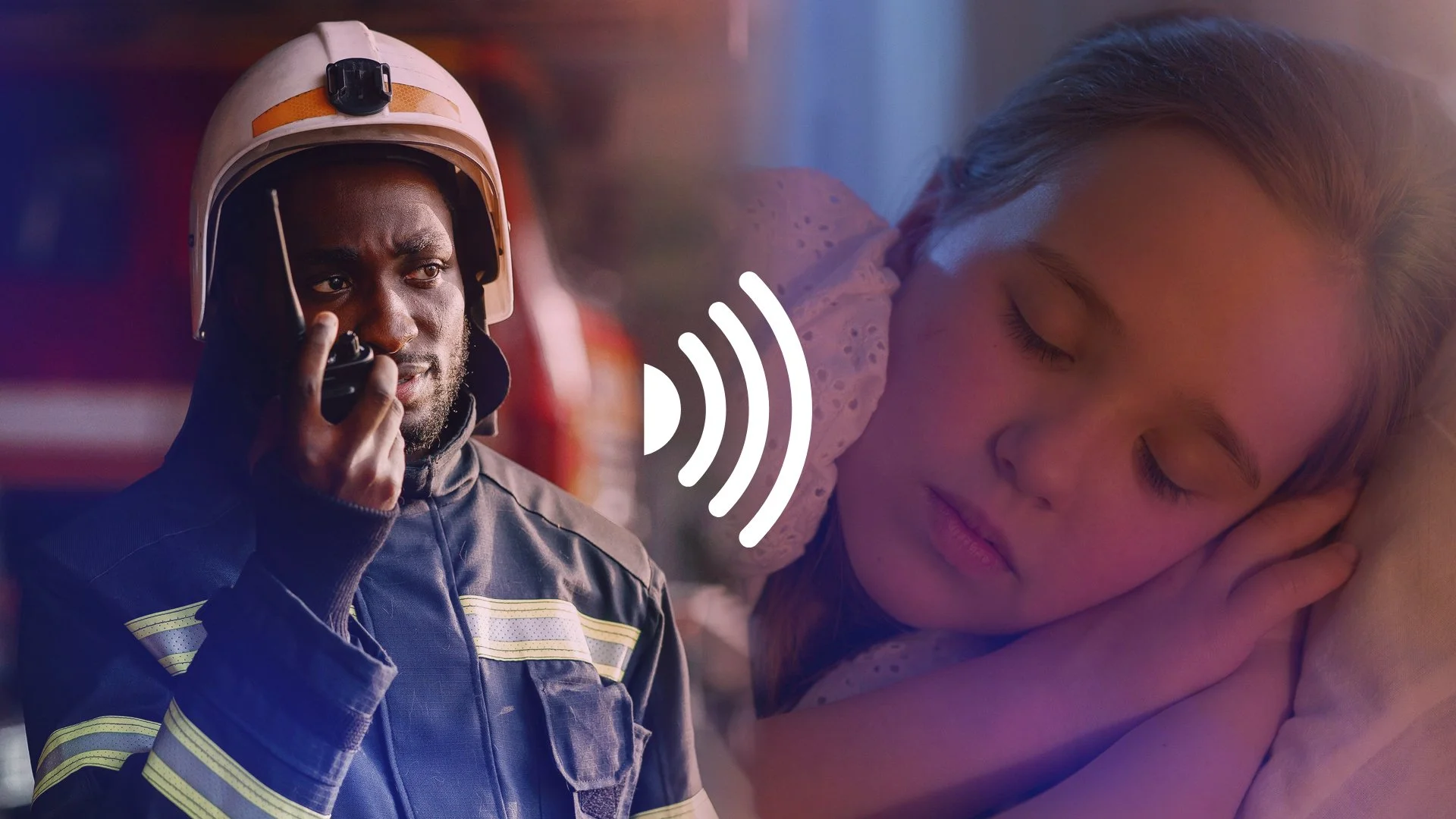
I work with sound for a living, so I thought very little about smoke alarms could surprise me. Then I read a study that genuinely shocked me.
Researchers at Nationwide Children's Hospital tested 540 sleeping children against the standard smoke alarm, the high-pitched beeping one screwed into the ceiling of almost every home you have ever been in.1 You would assume that piercing shriek wakes anyone. It doesn't. It woke only about half the children. Just over half escaped. Even the 12-year-olds, the oldest and most alert group in the study, managed only a 56% escape rate within the one minute that fire experts say can be the difference between life and death.1
Sit with that. The single sound we have collectively agreed to trust with our children's lives works roughly as well as a coin toss.
And here is the part that turned my shock into something closer to frustration: this is not new knowledge. Researchers have been showing since at least the mid-2000s that a human voice and a lower-pitched tone wake children far better than the standard beep,2-4 and that better alarm has been a required standard in places like hotels since 2014.1 We have known how to fix this for years.
The same study found a sound that works
In the very same experiment, researchers tried a different alarm. They combined a low, rumbling tone with a human voice calling out, "Fire! Fire! Wake up! Get out of bed! Leave the room!"1The result was not a slight bump. It was transformational. That voice-and-tone alarm woke and got more than 96% of children aged nine and up safely out of the room within a minute.1
Same children. Same fire. Same danger. A different sound, and almost all of them lived.
Why does a voice work where a beep fails? Two beautifully simple reasons. The classic alarm screeches at around 3,200 Hz, way up at the top of our hearing. The voice-based alarm sits much lower, far closer to the natural pitch of human speech, which our brains seem hardwired to notice even in deep sleep.1 And a voice does something a beep can never do. It carries meaning. A child jolted awake and groggy doesn't have to decode a noise and work out what to do. The alarm tells them.
This is the thing about sound that most of us never stop to consider. It is the fastest sense we have. Your brain registers a sound in roughly five hundredths of a second, about ten times faster than you can blink.5 And it doesn't take the scenic route. Sound plugs straight into the emotional, instinctive part of the brain before you have consciously thought anything at all. Designed well, a sound isn't decoration. It is one of the most direct lines we have into human behaviour.
This is not just about smoke alarms
Once you notice this, you start seeing it everywhere. Again and again, a smarter sound quietly changes what people do, and again and again, we shrug and stick with the same old sounds.
Take your car. Most of us have ignored that polite little seatbelt chime at some point in our lives. But when researchers made the reminder persist for at least 90 seconds, seatbelt use among habitual non-wearers jumped by a third. Their estimate? Rolling that out across the US alone could save close to 1,500 lives a year.6 From a longer beep.
Or tailgating, the cause of a startling share of road accidents. In a driving simulator, researchers fed drivers a warning that grew uglier and more grating the closer they crept to the car in front. Drivers backed off. They spent 16% less time riding dangerously close, and the unpleasant sound beat the pleasant one.7 Sometimes, when safety is on the line, a sound is supposed to make you uncomfortable.
Silent electric scooters are almost invisible to pedestrians, missed nine times out of ten in tests. Add a well-judged warning sound and that figure collapses.8 Hand someone a bleeding-control kit with written instructions and barely three-quarters use it correctly under pressure; add a calm spoken voice talking them through it and success climbs above nine in ten.9 Even hospitals, drowning in harsh, identical beeps that staff learn to tune out, have found that warmer, more musical alarm tones are dramatically less irritating while staying just as easy to recognise.10
The pattern could not be clearer. Thoughtful sound changes behaviour. It saves money, frustration and, in the starkest cases, lives.
So why are we still beeping?
Part of it is history. When alarms were invented, all the clever engineering went into the detecting, the sensing of smoke and heat. The actual sound, the bit a human being has to hear and act on, was an afterthought.1 And it has barely changed since.
Part of it is inertia. As I mentioned, that better alarm became a requirement in commercial spaces like hotels over a decade ago in the United States, and even longer ago elsewhere, yet most family homes still run the old high-pitched one.1 The science raced ahead. The habits and the rules lagged behind.
But a big part of it, honestly, is a blind spot. We are a culture obsessed with how things look. We agonise over logos, colours and screens, and we treat sound as a box to tick. A beep is a beep. Nobody asks whether it is the right beep.
That is the question we should all be asking, of the products in our homes, the apps on our phones, the brands we interact with every day. Was this sound actually designed? Or is it just there?
Sound deserves to be taken seriously
Here is what genuinely excites me about all this. Sound is one of the most powerful tools we have for shaping how people feel and what they do, and it is often the cheapest. A better warning costs no more to sound than a worse one. The science is sitting right there, tested and published. The only thing missing is the will to use it.
So the next time an alarm goes off, a notification pings, a checkout chimes, or a brand's sound catches your ear, pause for a second and really listen. Ask whether that sound was crafted with intent, or simply switched on and forgotten.
Because if something as simple as swapping a beep for a voice can wake nearly every sleeping child instead of half of them, imagine what we could do if we finally started treating sound like it matters.
It is time we listened.
References
Gary A. Smith, Sandhya Kistamgari and Mark Splaingard, 'Age-Dependent Responsiveness to Smoke Alarm Signals Among Children', Pediatrics, 149/5 (2022).
Gary A. Smith et al., 'Comparison of a Personalized Parent Voice Smoke Alarm with a Conventional Residential Tone Smoke Alarm for Awakening Children', Pediatrics, 118/4 (2006), 1623–32.
Dorothy Bruck, 'Non-Awakening in Children in Response to a Smoke Detector Alarm', Fire Safety Journal, 32/4 (1999), 369–76.
Dorothy Bruck et al., 'The Effectiveness of Different Alarms in Waking Sleeping Children', Proceedings of the 3rd International Symposium on Human Behaviour in Fire (Belfast, 2004).
Seth S. Horowitz, The Universal Sense: How Hearing Shapes the Mind (New York, 2013).
David G. Kidd and Jeremiah Singer, 'The Effects of Persistent Audible Seat Belt Reminders and a Speed-Limiting Interlock on the Seat Belt Use of Drivers Who Do Not Always Use a Seat Belt', Journal of Safety Research, 71 (2019), 13–24.
Michael Petersen, Barbara Deml and Albert Albers, 'The Effect of an Emotionalizing Sound Design on the Driver's Choice of Headway in a Driving Simulator', Acoustics, 6/2 (2024), 541–67.
T. Walton et al., 'Evaluation of Auditory Alerting Systems for Safe Electric Scooter Operations', Scientific Reports, 15 (2025), 3424.
Saumil Dayal et al., 'Measuring the Effect of Audio Instructions on the Time and Effectiveness of Tourniquet Application by Laypeople', Prehospital Emergency Care, 27/5 (2023), 613–17.
Cameron J. Anderson et al., 'Improving Auditory Alarms: Reducing Perceived Annoyance with Musical Timbre (a Randomized Trial)', Perioperative Care and Operating Room Management, 32 (2023), 100332.