

Why Chasing ROI Could Be Costing Your Brand Its Most Underused Asset
Sonic branding is a long-term asset, not a line item.
If you are a marketer under pressure to prove the efficiency of every pound, you are not alone, and you are not wrong to care. But a recent WARC webinar with Les Binet, one of the most respected voices in marketing effectiveness, made a case that should give every brand manager a pause. Presenting the research behind his new IPA report with Will Davis, Go Big or Go Home,1 Binet argued that the industry's obsession with Return on Investment is quietly undermining the very growth it is meant to deliver. Buried in his findings is a lesson that matters greatly for how you should think about sound.
The numbers are eye-opening, since Covid advertising ROI has gone up by about 4%, but the extra profit from advertising has actually dropped by around 11% in real terms.1 Binet’s analysis of the IPA Databank shows that budget matters eight to nine times more than ROI when it comes to driving profit.1 As he put it, "Maximising ROI is not the way you grow."
This idea directly affects a choice your brand might currently be facing: how you approach and value sound.
You are probably buying music when you should be building a brand
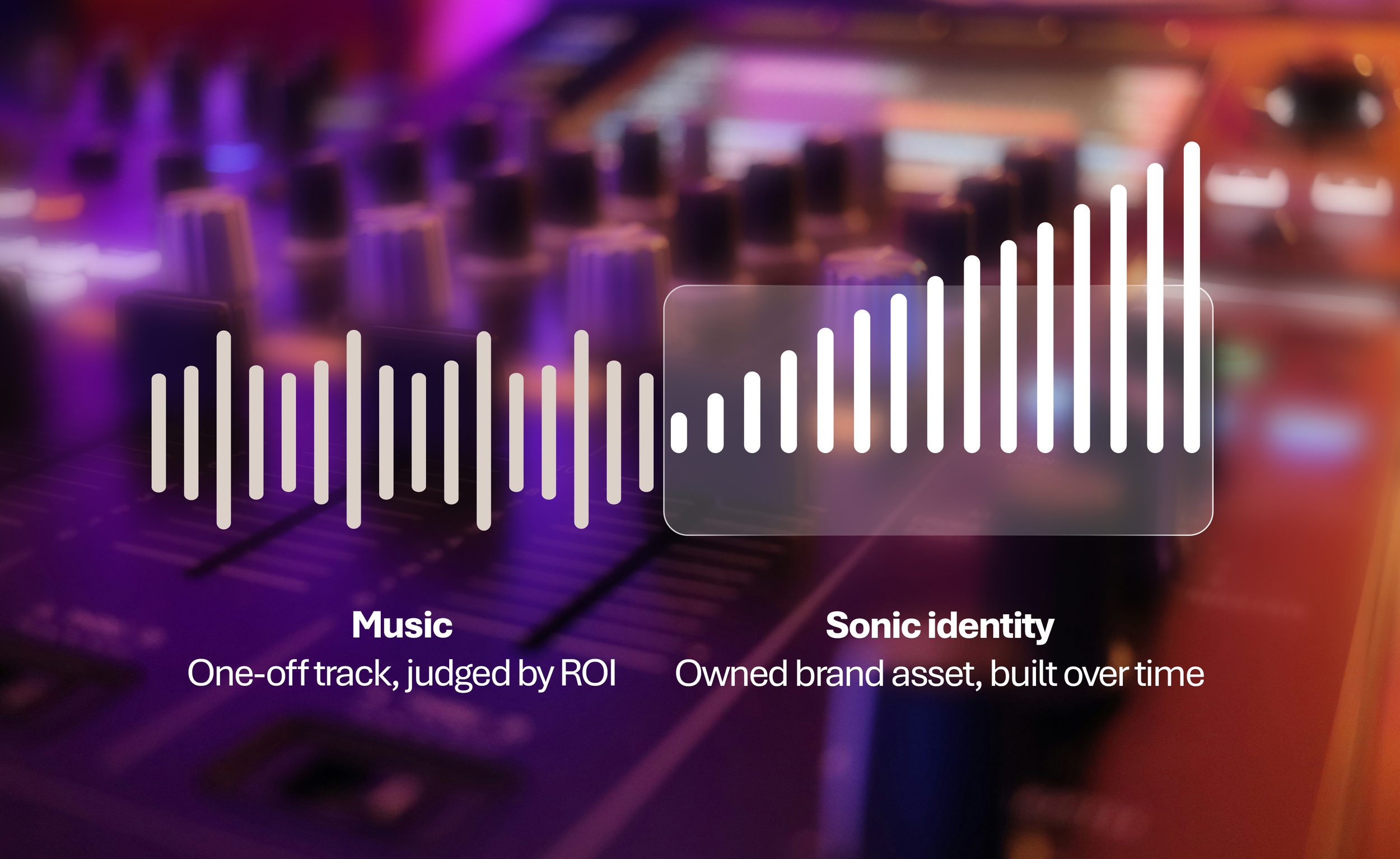
When brands think about music for a campaign, their default is to go to a production house or if budget is tight tack on stock music. The brief usually comes with a tight deadline, and therefore little strategic thought is put into the music. As a result, success is often measured by short-term ROI on just one asset.
This is the trap Binet warns about. Focusing on the efficiency of a single project isn’t the same as creating something that grows in value over time. A production house can give you a track, but a sonic branding partner offers more: they help you build a unique, strategic sonic identity that makes your brand stand out and become more memorable across every touchpoint as you use it consistently over time.
The clue is in the word "branding," and it is the word most often forgotten. Sound branding is the strategic, systematic use of sound and music to communicate your brand's identity, values and personality across every consumer touchpoint, making it as meaningful as your visual identity.2,3 It is the sound equivalent of your visual logo, your colour palette and your tone of voice, not a one-off music track. If you treat it as a transaction, you will buy music. If you treat it as branding, you will build equity.
Sound is quietly doing the heavy lifting in your advertising
Binet argued that attention is the most important factor in how well a format works. The longer people watch, the greater the impact on sales, both short and long term, up to about twenty or thirty seconds. But here’s the surprising part: your ads still influence people even when they are not looking at the screen; this is all thanks to sound. A 2026 Dentsu study, mentioned by Binet, found that sound makes up about 20% to 30% of the total sales effect in video ads.4 That’s why audio is so powerful on platforms like YouTube and TikTok.
Binet put it well: "Non-skippable ads work a bit like radio with sound doing a lot of the work. You can look away from the screen, but you can't close your ears."5 Think about how your customers consume content. They glance at their phones, scroll, multitask, or turn away. When that happens, your visual brand cues disappear, but your audio choices keep working. For up to a third of your video’s sales effect, sound is what keeps your ad present.
Still, most brands don’t take advantage of this. Ipsos research found that ads with sonic brand cues are about 8.5 times more likely to get top marks for branded attention than those without, but only about 6% of video ads use them.6 Sound is one of the most powerful and underused tools your brand has, especially since the brain processes sound in about 0.05 seconds, ten times faster than the blink of an eye.7
The catch: sound only pays back when it is designed, not left to chance
You might think the answer is simply to turn up the audio, but that would be a mistake. Binet made it clear that the quality of attention is what counts: people pay more attention when they choose to, and effectiveness depends on emotion, relevance, and strong, unique branding. Binet urged brands to "use your distinctive brand assets to make sure everyone is crystal clear which brand is in the ad".1 Sound can be one of your most distinctive assets, but only if it’s designed to be unique and used consistently.
You wouldn’t let an intern choose your brand colours at the last minute, but many brands still treat their sound as such, like an afterthought. The evidence shows this can be a costly mistake. Here’s what you gain when you treat sound as a strategic branding decision:
- Brands that use music that matches their core identity are 96% more likely to be remembered by consumers.8 The key is fit, not volume. Music that doesn’t fit your brand can be worse than having no sound at all.
- Good, engaging music can raise marketing ROI by an average of 32%, and campaigns with music are 27% more likely to see big business results.9 (Binet himself co-authored some of the best evidence for the commercial power of sound.)
- A well-known sonic logo can make consumers about 17% more willing to pay for a low-involvement product,10 directly boosting the pricing power and margins that strong brands depend on.

The leaders already understand this. Mastercard built a holistic, ownable sonic identity rather than licensing music, and reported a 2x increase in consumer transaction confidence following its rollout.11 Decades earlier, Intel's five-note mnemonic helped grow consumer awareness from 8% to 85% within eighteen months, turning a few seconds of sound design into a multi-million-dollar brand asset.12 More recently, TikTok launched its sonic logo in October 2022, built around longevity by becoming a sonic watermark at the end of every video shared outside of it’s platform. When we tested it just nine months later among its core Gen Z audience, it had already achieved 70% recognition and 47% unaided brand attribution13, proof of how quickly an ownable, consistently used sound can embed itself in consumers' minds. None of these results came from a brief asking, "What's the cheapest, most efficient way to have sound and music?" All came from treating sound as brand infrastructure.
So, before your next sonic project, try not to focus only on efficiency. The better question is the one Binet keeps returning to: what creates lasting value? Working with a specialist sonic branding agency, rather than just a music supplier, is the best way to find out, because a sonic branding partner ensures fit, uniqueness, consistency, and most importantly, long-term strategy.2,3
What this means for your brand
On the surface, Binet’s Go Big or Go Home is about budgets and media scale, but for me the real lesson applies directly to your brand’s audio strategy. Focusing on ROI for individual assets can quietly weaken the factors that drive real growth, and sound is one of the most overlooked of these. Here are three key takeaways. First, the aim of sonic branding is to build brand equity, not just supply music efficiently. Therefore, judging effectiveness by single-asset ROI can be misleading. Second, new research shows sound accounts for 20% to 30% of your video’s sales effect and keeps working even when people aren’t watching, making it a true driver of effectiveness. Third, this power only comes when sound is designed as carefully as your visual identity: it should be unique, fit your brand, connect emotionally, and be used consistently over time. The real goal isn’t a high ROI on one track. It is a sound your customers know, trust, and remember for years.
References
Binet, L. and Davis, W. (2026) Go Big or Go Home: How 'small thinking' is killing advertising and what to do about it. London: IPA. (See also the WARC Talks webinar, 27 May 2026, and IPA Databank figures cited therein.)
Minsky, L. and Fahey, C. (2017) Audio Branding: Using Sound to Build Your Brand. London: Kogan Page.
Groves, J. (2009) ABC of Audio Branding. Hamburg: Baird.
Dentsu (2026) The Brand Reset: Capturing Sales and Brand Equity from Attention, cited in Binet, L. and Davis, W. (2026) Go Big or Go Home. London: IPA.
Radio Advertising Bureau (2009) You Can't Close Your Ears. RAB.
Ipsos (2020) Why Sound Matters to Your Brand (The Power of You). Ipsos.
Horowitz, S.S. (2013) The Universal Sense: How Hearing Shapes the Mind. New York: Bloomsbury.
North, A. and Hargreaves, D. (2008) The Social and Applied Psychology of Music. Oxford: Oxford University Press.
Binet, L., Müllensiefen, D. and Edwards, P. (2013) 'The power of music', Admap, October.
McKenzie, J. (2010), cited in SoundOut (2021) research on sonic logo value.
WARC (2020) Mastercard Sonic Melody. World Advertising Research Centre.
Reese, C. (2015) Mute Brand. Frankfurt: Mute Brand.
amp (2023) Proprietary sonic brand recognition study: TikTok, Gen Z audience. Internal research, late summer 2023.