

Only two grocery brands make the global top 30 for sonic performance, as Kroger tops the US table at 6th and new research reveals a wider failure to build distinctive, owned sound
September 29, 2026 – America may have invented the advertising jingle, but US grocery brands are being outpaced by international rivals when it comes to turning sound into a distinctive brand asset, according to a new global study.
Research from amp, a global sound-branding specialist that helps brands build distinctive audio identities and is part of WPP’s brand and design collective, analyzes the sonic strategies of 100 grocery brands worldwide.
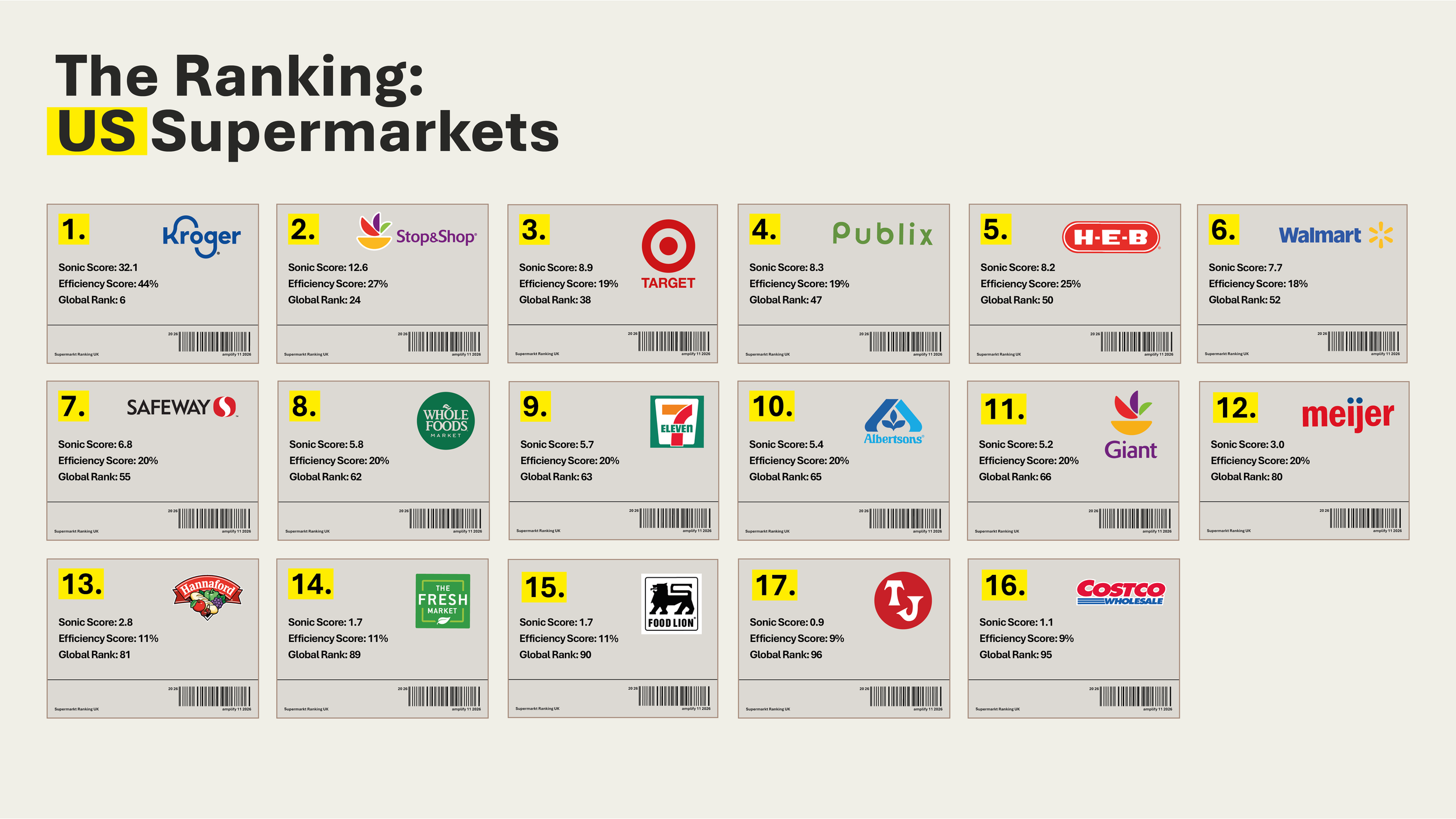
Published in The Sound of Grocery Shopping, Issue 11 of amp’s amplify series, the research assesses brands across five dimensions – Experience, Trust, Belonging, Recognition and Engagement – to examine how effectively sound is being used to build brand identity.Kroger is the only US grocery brand analyzed that makes the global top 10. Second is Stop & Shop at 24th followed by Target at 38th, Publix 47th and H-E-B at 50th. Walmart ranks 52nd, Safeway 55th and Whole Foods 62nd.The ten highest-ranked US brands in amp’s global study are:
Kroger – 6th globally
Stop & Shop – 24th
Target – 38th
Publix – 47th
H-E-B – 50th
Walmart – 52nd
Safeway – 55th
Whole Foods – 62nd
7-Eleven – 63rd
Albertsons – 65th
America invented the jingle. So what happened?
Across all 100 brands analyzed, 63% of content uses stock music, while 77 brands use stock music in at least half of their content.
Only 31 have a sonic logo, while just 15 use owned music. By contrast, every brand in the global top 10 has a sonic logo and nine use owned music.
The regional difference is particularly pronounced. Around 20–25% of North American brands have sonic logos, compared with approximately 40–45% in Asia and South America.
North America’s sonic logos are also relatively young, averaging around one year old, suggesting much of the region has only recently begun treating sound as a systematic brand asset.
Owning sound is only the beginning
The study also finds that creating a sonic identity is not enough if brands fail to deploy it consistently.
Kroger leads North America on key audio-strategy measures, with its “Doin’ It Fresh” sonic logo appearing in 34% of content and owned music in 30%. But 37% of its content still relies on stock music. At the other extreme, Whole Foods relies on stock music for 94% of its content.
The same challenge extends into digital experiences. Across the global study, 29 brands have apps featuring UX or UI sounds, yet only 11 of those brands also have a sonic logo – leaving many functional audio touchpoints disconnected from a wider brand identity.
Michele Arnese, Founder and Global CEO of amp, said: “North America has a rich history of brands using music to become part of popular culture, but the opportunity today goes far beyond the jingle.
“Brands now have to be recognizable across stores, apps, social platforms, creator content and AI-enabled experiences. Sound is one of the few assets that can travel across all of those spaces, yet grocery brands are still largely relying on music that anyone else can use.”
Discount brands play the long game
Globally, the research also finds that discount supermarkets are investing more consistently in owned sound than premium competitors.
Discount brands use around 4.5% owned music compared with 1% among premium brands, while almost three times as many discount supermarkets have a sonic logo.
Those assets have also been built over much longer periods: the average discount supermarket sonic logo is around 15 years old, versus just 4.5 years for premium brands.
Björn Thorleifsson, Director of Research & Insights at amp, said: “Our research shows the gap isn’t about adding more sound. It’s about ownership and consistency. North American grocery brands have an enormous number of sonic touchpoints already, but relatively few are connecting them into a distinctive system. That is where the opportunity lies.”
Download the report: amp – amplify